Recent industrial humanoid robot programs have made joint hardware a more serious material-selection topic. The visible story is software, balance, perception, and dexterous manipulation. The practical hardware story is more grounded: compact actuators, wrist links, bearing seats, latch blocks, cable-protected brackets, and end-effector supports all need to fit inside tight envelopes without wasting payload.
That is where the Ti64 vs 17-4PH powder decision becomes useful. These alloys do not compete as generic “strong metals.” They solve different parts of the robot joint problem. Ti64 powder is usually strongest when moving mass, specific strength, and stiffness-to-weight matter near the distal arm, wrist, or tool side. 17-4PH powder is usually strongest when the part needs a heat-treatable stainless route for actuator housings, latch hardware, bearing-adjacent structure, and compact loaded interfaces.
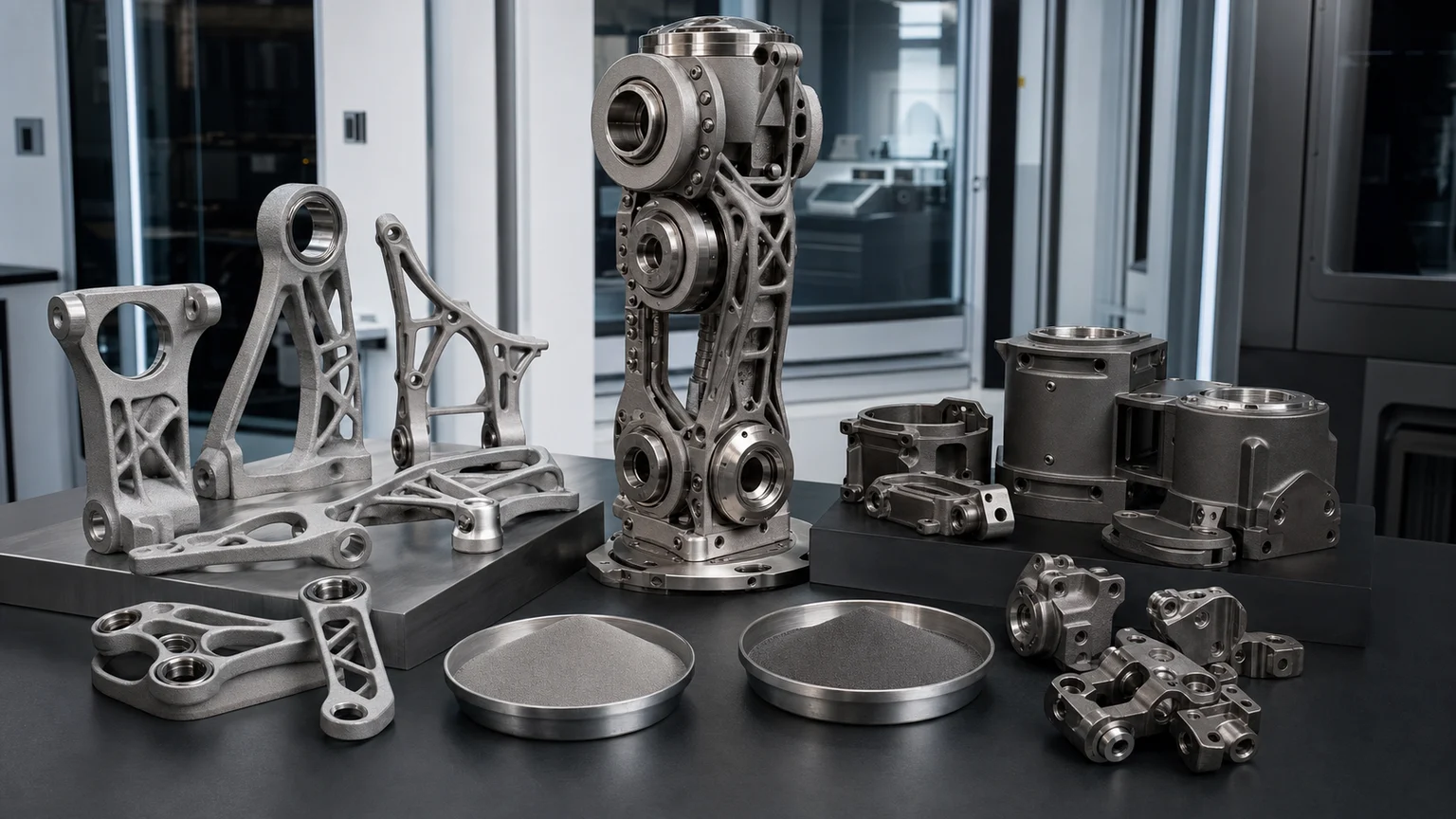
The right choice is rarely a single-material answer for the whole robot. A better design review asks where each alloy belongs in the joint stack and where aluminum, 316L, tool steel, or conventional machining may still be cleaner.
Why humanoid robot joints are a different powder problem
Humanoid robot hardware is not just a scaled-down industrial robot arm. A humanoid has many joints, repeated acceleration, distributed actuators, tight service access, cable routing, sensors, covers, and load paths that change with posture. A small material penalty repeated across shoulders, elbows, wrists, hips, knees, ankles, and hands can become a system-level penalty.
This creates several competing goals:
- reduce mass at the moving end of the kinematic chain
- preserve stiffness around bearings, encoders, and tool interfaces
- keep actuator housings compact enough for human-like envelopes
- avoid local thread, latch, or contact failures after repeated cycles
- leave enough stock for machining datum faces and precision bores
- support inspection, heat treatment, and recurring production
The powder decision should follow those goals. A robot wrist link with lattice-like ribs is not the same material problem as a gear-side actuator housing. A cable-protected sensor bracket is not the same as a latch block. Treating all of them as “robot metal parts” is how teams overpay for titanium in the wrong places or under-specify stainless parts that see real contact stress.
Where Ti64 powder fits best
Ti64 powder, commonly discussed through the TC4 / Ti-6Al-4V powder guide, is attractive when the joint component is mass-sensitive and geometrically dense. The value is not only the alloy strength. It is the combination of specific strength, LPBF design freedom, and the ability to place material only where it helps the load path.
Good Ti64 candidates in humanoid and robot joint hardware include:
- distal-arm and wrist-side links where lower mass improves response
- end-effector frames that carry grippers, sensors, or tooling
- lightweight brackets with several mounting planes
- lattice or ribbed support structures around non-contact volume
- sensor payload mounts where stiffness and low mass matter together
- compact cable-protected covers that also carry local structure
This is close to the logic in the Ti64 robotic arm bracket page, but humanoid joints make the tradeoff sharper. Because the robot may repeat similar moving structures many times, every gram saved near the hand or wrist can support better acceleration, lower actuator load, or more payload margin.
Ti64 also fits when the geometry looks more like a structural node than a simple block. If the part can combine angled ribs, local bosses, protected cable paths, and machined pads, the economics are easier to justify. The Ti64 lattice bracket guide is a useful companion when the design intent is weight reduction through load-path geometry.
Where 17-4PH powder fits best
17-4PH powder belongs on the stronger stainless side of the joint stack. It is heavier than Ti64, but that can be acceptable when the part sits closer to the actuator, frame, or load-transfer interface and needs higher strength, local hardness, or repeat-use mechanical margin.
Good 17-4PH candidates include:
- compact actuator housings with dense mounting interfaces
- gear-side covers and bearing-adjacent bodies
- latch blocks, locking links, and release hardware
- reinforced mounting ears and clevis-style connectors
- sensor-protected stainless brackets near loaded mechanisms
- small parts where thread strength or contact wear matters
For these components, the closer reference is the 17-4PH automation actuator housing and latch guide. The alloy’s precipitation-hardening route matters. A 17-4PH printed part is not just a stainless shape. Its final value depends on the build route, heat treatment, dimensional stability, machining plan, and the final condition requested on the drawing.
17-4PH is also a useful alternative when 316L would be too soft for the duty. The broader 17-4PH stainless steel powder guide explains the alloy route, while the 316L vs 17-4PH powder comparison is helpful when the question is corrosion-first stainless versus stronger stainless.
A practical Ti64 vs 17-4PH decision table
| Joint hardware question | Ti64 powder is usually stronger when… | 17-4PH powder is usually stronger when… |
|---|---|---|
| Moving mass | The part is near the wrist, hand, distal arm, or tool side. | The part is close to the actuator or frame and weight is secondary. |
| Geometry value | Ribs, lattices, cable paths, and multi-axis bosses reduce mass and assembly count. | Complex housings, latch bodies, and compact reinforced interfaces reduce assembly count. |
| Contact and wear | Contact zones are limited and can be machined, bushed, or protected. | Repeated latch, thread, bearing-adjacent, or local contact loads are central to the part. |
| Cost pressure | The system-level value of lower mass justifies titanium powder and post-processing. | Stainless economics and heat-treatable strength are more important than minimum mass. |
| Post-processing | Stress relief, machining, surface finishing, and inspection are planned around titanium behavior. | Aging condition, machining, hardness or strength targets, and dimensional stability are specified. |
| Best examples | Wrist links, end-effector frames, sensor mounts, lightweight bracket nodes. | Actuator housings, lock plates, latch blocks, bearing support bodies, stronger mounting ears. |
The table is intentionally part-led. A humanoid shoulder bracket and a wrist-side sensor frame should not receive the same answer just because both are on the same robot.
LPBF powder details that affect both choices
Most compact humanoid joint hardware discussions will start with LPBF because it can support fine features, dense parts, and precise near-net shapes. The material choice still needs to be tied to powder quality and build planning.
For both Ti64 and 17-4PH, the RFQ should identify:
- particle-size distribution, commonly in the 15-45 um or 15-53 um LPBF range
- chemistry limits and lot traceability
- oxygen and contamination control
- morphology, flowability, and apparent density expectations
- build orientation and support strategy
- heat treatment or stress-relief route
- machined datum faces, bearing bores, dowel holes, and thread strategy
- inspection level, including dimensional reports, coupons, or CT when needed
The LPBF powder particle size guide is a good starting point for size range and process fit. The metal powder specification guide is the better reference when the sourcing discussion needs PSD, oxygen, flowability, and traceability language.
Where neither alloy should be forced
Ti64 and 17-4PH are useful, but neither should become the default answer for every humanoid robot part.
Use aluminum powder or machined aluminum when the part is a low-load cover, electronics housing, or simple lightweight support. AlSi10Mg may be enough when stiffness, thermal behavior, and cost are more important than titanium strength. Use 316L when the part is corrosion-aware, fluid-adjacent, or stainless but not highly loaded. Use a tool steel or maraging steel route when the part behaves more like production tooling, wear tooling, or compact high-strength fixture hardware than a robot joint component.
Conventional machining also remains the cleanest path for simple plates, shafts, spacers, and blocks. Additive manufacturing is strongest when the part needs geometry that machining would struggle to produce as one economical piece.
How to write the RFQ so suppliers quote the right route
A useful robot joint powder inquiry should describe the part’s function before it names the alloy. A short RFQ checklist should include:
- joint location, such as shoulder, elbow, wrist, hand, hip, knee, or ankle
- whether the part moves with the distal chain or stays near the actuator/frame
- estimated load direction, duty cycle, and vibration concern
- target mass or envelope limit
- bearing, bushing, dowel, thread, and datum requirements
- surfaces that must be machined after printing
- heat-treatment expectation and property target
- allowable surface condition on nonfunctional areas
- inspection level for prototypes versus recurring builds
- whether the design is a one-off test article or a platform part
Those details help prevent the common mismatch: Ti64 quoted for a heavy actuator housing where stainless would be more practical, or 17-4PH quoted for a wrist-side structure where mass is the actual constraint.
Related material guides for robot-joint projects
For a robot joint program, it helps to route the decision through a small content map instead of jumping straight to one alloy:
- start with titanium powder when low mass and high specific strength are central
- use stainless steel powder when the need is stronger stainless or corrosion-aware mechanical hardware
- review industrial automation and robotics for actuator housings, robotic arm brackets, wear parts, and tooling-adjacent automation hardware
- use the humanoid and robot joint hardware hub when the project is specifically about joints, wrist links, end-effectors, and actuator-side parts
- use LPBF powder when the question is process fit, particle-size range, and near-net geometry
Start with the part’s load case and interfaces. Then choose the alloy, powder route, post-processing, and inspection plan that match those requirements.
The practical takeaway
Use Ti64 powder when humanoid robot joint hardware needs low moving mass, stiffness-to-weight, and compact additive geometry near the wrist, hand, distal arm, or end effector. Use 17-4PH powder when the part needs stronger stainless behavior, actuator-side packaging, bearing-adjacent structure, latch features, or repeat-use loaded interfaces.
The best humanoid robot joint design may use both: Ti64 for lightweight moving links and 17-4PH for compact actuator-side housings and locking hardware. The procurement question is not “which alloy is better?” It is “which part of the joint stack needs which alloy, and what powder, heat treatment, machining, and inspection plan will make that choice reliable?”